
Improving patient pathway for shoulder dislocations through clinical innovation
This real-world patient care scenario demonstrates one trust’s experience with a specific solution available through our frameworks. The inclusion of supplier names and/or products in this testimonial are intended strictly for educational purposes and does not constitute an endorsement of the individual suppliers by NHS Supply Chain.
The results and findings presented are specific to the project featured – other approved products are available. As a supplier-agnostic organisation, we support informed choice across the full range of solutions within each category.
Introduction
Shoulder dislocation is the most common large-joint dislocation seen in Emergency Departments and is associated with severe pain and distress. In the UK, the incidence is 40.4 per 100,000 person-years in men and 15.5 per 100,000 person-years in women.
An internal audit at South Tyneside and Sunderland NHS Foundation Trust identified that patients with shoulder dislocations were experiencing significant delays to treatment, extended lengths of stay, and a high reliance on procedural sedation.
Procedural sedation, while sometimes necessary, carries recognised risks, requires multiple staff members, monitored cubicles, and recovery time, and can exacerbate pressures on Emergency Department flow.
The challenge
The existing pathway meant that:
- Many patients waited several hours for reduction despite it being a condition that can often be managed promptly.
- More than half of patients required sedation, increasing clinical risk and resource use.
- Care was often dependent on senior doctor availability, limiting timely intervention.
The aim
The clinical and innovation team at South Tyneside and Sunderland set about reviewing options to improve the pathway and patient experience.
The aims of the pathway change were to:
- Introduce a standardised, evidence-based approach.
- Improve patient experience.
- Reduce reliance on procedural sedation.
- Improve patient flow through the Emergency Department.
- Use NHS resources more efficiently.
- Support NHS priorities around patient safety, workforce optimisation and reducing avoidable harm.
The solution
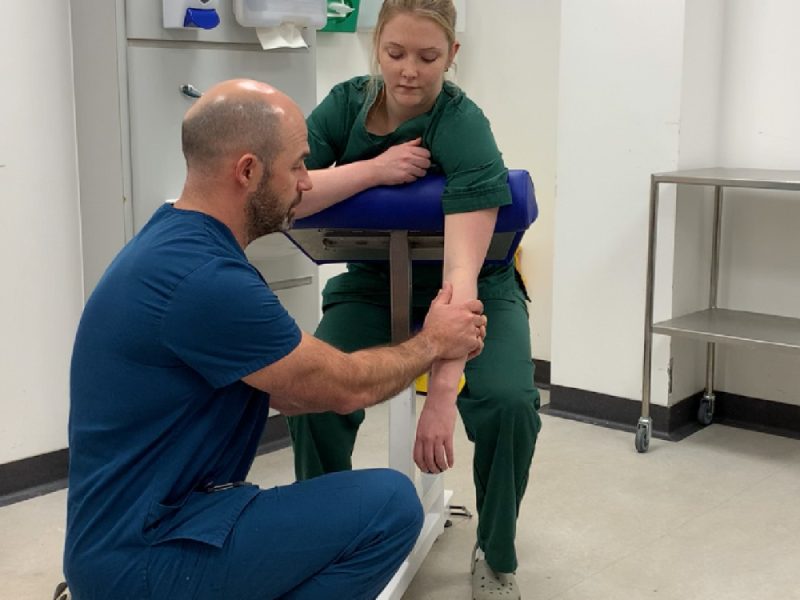
A wide-ranging literature review by the trust supported this need for change, demonstrating that upright, gravity-assisted shoulder reduction techniques can significantly reduce the need for procedural sedation while maintaining safe and effective reductions.
More recent published evidence by South Tyneside and Sunderland NHS Foundation Trust, including a 2025 study in the European Journal of Emergency Medicine, further supports that the use of a Shoulder Reduction Bench substantially reduces sedation and analgesia requirements without compromising outcomes.
The programme team developed a Shoulder Reduction Bench, adapted from the “Oxford Chair” technique, which allows patients to sit upright while gravity assists muscle relaxation and shoulder reduction.
The intervention was designed to be:
- Cost effective
- Low force
- Low risk
- Suitable for use in a busy Emergency Department.
Implementation approach
Key elements included:
- Equipment introduction: A purpose-designed bench was manufactured and approved as a low-risk medical device.
- Clear protocol development: Written guidance and flowcharts established patient inclusion and exclusion criteria to ensure appropriate, safe use.
- Workforce upskilling: Emergency Nurse Practitioners (ENPs), junior doctors, and senior staff received training through teaching sessions, supported by instructional videos to ensure sustainability despite staff rotation
- Staff empowerment: ENPs were supported to carry out shoulder reductions independently where appropriate, reducing reliance on senior doctor availability.
- Quality improvement approach: The team used Plan–Do–Study–Act (PDSA) cycles, process mapping, and continuous data monitoring to embed change and respond to early learning.
Importantly, this clinically led pathway change focused not only on introducing new equipment, but also on supporting cultural change, increasing staff confidence and normalising sedation-sparing approaches where safe to do so – an approach aligned with emerging evidence and best practice.
The results
Following implementation, the data demonstrated clear and measurable improvements across patient experience, safety, productivity and efficiency:
BMJ 2019 Open Quality publication findings:
Average time from arrival to confirmed shoulder reduction reduced by 31 minutes.
Average time from arrival to discharge reduced by 52 minutes.
Procedural sedation rates fell from 57% to 18%, representing a 68% reduction.
These results demonstrate that the use of a Shoulder Reduction Bench can significantly reduce reliance on procedural sedation and analgesia, supporting safer and more efficient care delivery.
Published evidence from the European Journal of Emergency Medicine 2025 substantiated the 2019 findings:
- Sedation rates reduced from 57.7% to 19.5%.
- Successful treatment by junior staff increased from 50% to 74%.
- The bench was used in 74 of 87 cases (85%).
- Successful reductions without sedation were achieved in 57 of the 74 cases (77%).
Maintained safety
- No significant complications were reported
- Clear protocols reduced inappropriate use of the technique
- Patients who could not be successfully treated using the bench were safely escalated to sedation
Workforce benefits
- Increased confidence among Emergency Nurse Practitioners.
- Improved staff satisfaction.
- Reduced reliance on senior doctor intervention.
- Reduced sedation-related staffing requirements.
System benefits
- Improved Emergency Department flow.
- Reduced demand for monitored beds.
- Reduced recovery area utilisation.
- More efficient use of workforce and departmental capacity.
Overall, the pathway change has demonstrated that this intervention, when combined with structured training and governance, delivered meaningful improvements aligned with NHS priorities for safer care, better patient experience, and more efficient use of limited resources. The success and staff engagement helped embed the change into routine practice and generated wider organisational interest.
Key NHS takeaway
The Shoulder Reduction Bench pathway change demonstrates how a cost-effective innovation, supported by emerging evidence and workforce empowerment, can:
- Reduce procedural sedation
- Improve patient flow
- Enhance patient experience
- Increase workforce flexibility
- Support safer and more efficient care delivery.
The pathway change also highlights the importance of combining innovation with training, governance and staff empowerment to achieve sustainable pathway transformation.
Following conversations between South Tyneside and Sunderland NHS Foundation Trust and our Care Pathway team, the Shoulder Bench was progressed through our innovation route and is available to purchase through NHS Supply Chain catalogues.
To learn more about the Shoulder Reduction Bench for your organisation please contact your Clinical Care Pathway Manager.
Care Pathway Team
Links section
-
Care Pathway Team
Helping improve the link between procurement and clinicians and driving the adoption of innovation.
-
Real-world clinical examples
More examples of how we are working with the NHS to shift from cash releasing savings to Value Based Procurement.
-
BMJ Open Quality publication June 2019
BMJ Quality Improvement report: Shoulder Reduction Bench Project: improving care for patients with shoulder dislocations
-
How this piece of equipment helps treat a dislocated shoulder
Video created by South Tyneside and Sunderland NHS Foundation Trust on YouTube
-
Modified Shoulder Reduction Bench Training Video
A YouTube training video for medical practitioners in how to use a modified shoulder reduction bench to help reduce ANTERIOR shoulder dislocations without sedation.